
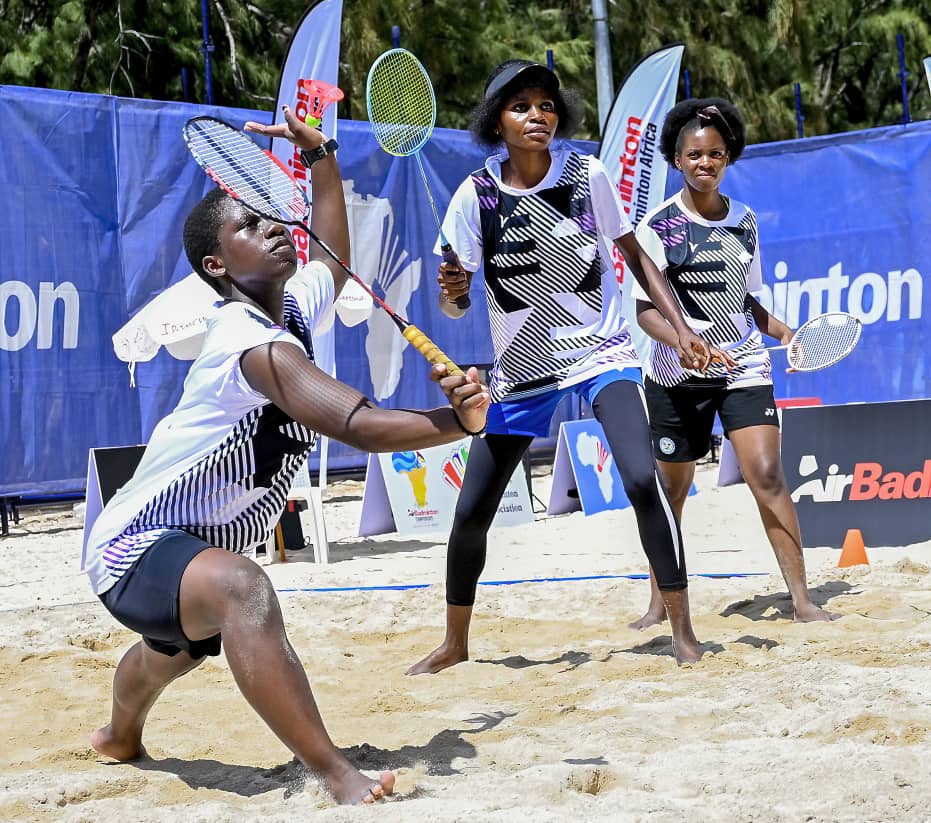
No Bikini,No Beach, Airbadminton Invades Aero
By Kayiira Jackson
The sand will be warm, the breeze will be unpredictable, music will fill the air and Lake Victoria will provide the backdrop.
But beneath the relaxed beach atmosphere, a continental battle will be unfolding.
For four days, from September 16 to 19, Aero Beach in Entebbe will trade its usual leisurely beach lifestyle for the intensity of competitive sport as 14 African nations descend on the shores of Lake Victoria for the third Africa AirBadminton Championship.
The hosts, crowned champions in 2024, will have to defend their title against Algeria, Benin, Burkina Faso, Burundi, Comoros, defending champions Egypt, Tunisia, Nigeria, Kenya, Mauritius, Rwanda, Zambia and Zimbabwe.
Two courts will be set up at the same venue, creating a rare sporting spectacle where players will have to battle not only opponents but also the elements.
At Aero Beach, the usual sounds of waves, conversations and beach entertainment will be joined by the distinctive thud of rackets striking the AirShuttle, cheers from supporters and the constant movement of players fighting for every point.
For Uganda, this is more than another championship.
It is a chance to prove that the 2024 triumph was not a one-off.
Uganda arrived at the inaugural championship in Mauritius with little experience of the outdoor version of badminton.
Augustus Owinyi, Muzafaru Lubega, Olivia Nakajja, Malha Musa, Sharifah Mbabazi and Fred Kadoli were among the players who delivered the historic triumph under coach William Kabindi.
Uganda also won gold in the Women’s Triple event and collected silver in the Men’s Triple.
That success, however, has changed the equation.
Uganda is no longer the unknown team arriving on the beach to surprise everyone.
Now, they are the team everyone wants to beat.
AirBadminton brings a completely different personality to badminton.
There is no polished indoor hall, no perfectly controlled environment and no escape from nature.
At Aero Beach, players will have to read the Lake Victoria breeze, adjust their movement on sand and cope with conditions that can change the flight of the AirShuttle.
The same breeze that gives spectators a refreshing beach experience could become a nightmare for a player trying to place a winning shot.
The sand also changes the game.
Movement becomes more demanding, quick recovery is harder and every step requires greater physical effort.
For spectators, however, the combination could be irresistible: competitive badminton played against the backdrop of Africa’s largest lake, with the relaxed energy of Entebbe’s beach culture surrounding a high-stakes continental championship.
Uganda’s current squad has already moved into preparation mode at Mbogo High School.
Reagan Nsubuga, Muzafaru Lubega, Bruno Agaba and Denis Mukasa are among those training, while Tracy Naluwoza, Gladys Mbabazi, Olivia Nakajja and Malha Musa are also in camp.
Three members of the squad that conquered Mauritius return, bringing something that cannot be taught in a classroom or training session: experience of winning an African championship.
But the challenge will be greater this time.
Egypt returns as the defending champion, while Nigeria and a growing list of African nations arrive with ambitions of taking Uganda’s crown.
What is Air badminton?
AirBadminton is essentially badminton’s outdoor cousin, developed by the Badminton World Federation (BWF).
Instead of the conventional indoor shuttlecock, players use the heavier and more wind-resistant AirShuttle, allowing the game to be played on sand, grass and hard outdoor surfaces.
The triples format makes the spectacle even more interesting.
In 3v3 action, a player cannot hit the AirShuttle twice consecutively. Every return must involve a teammate, forcing players to communicate, rotate and anticipate constantly.
The doubles and triples court measures 16 metres by six metres, while singles is played on a 16-by-five-metre court.
A two-metre dead zone on either side of the net adds another tactical challenge because the AirShuttle cannot land there.
Matches are played best of five games, with each game going to 11 points. At 10-10, a player or team must establish a two-point advantage, unless the score reaches the 13-point cap.
It is badminton stripped of the controlled indoor environment and given a dose of sun, sand and wind.