
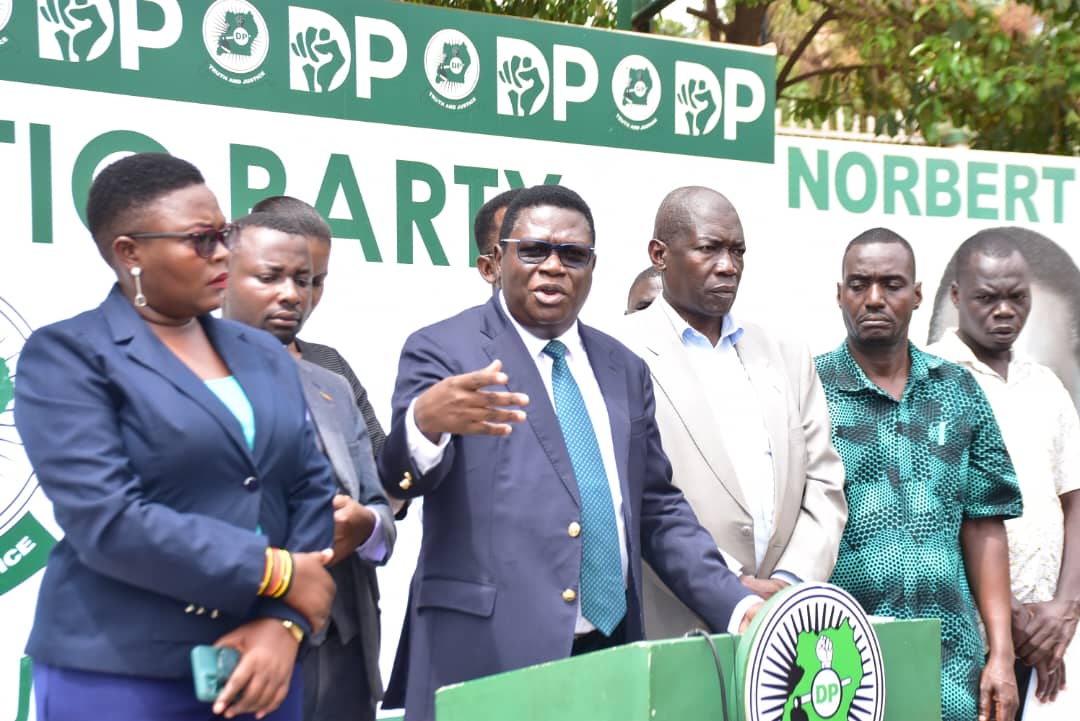
“We Can’t Change Our Destiny, We Only Change the Path to It” — Norbert Mao Defends DP Strategy
By Kyeyune Ali
Democratic Party (DP) President General and Minister for Justice and Constitutional Affairs Norbert Mao has defended his party’s cooperation agreement with the ruling National Resistance Movement (NRM), insisting that while the Democratic Party’s ultimate objective remains to attain state power, achieving that goal requires a change in strategy rather than abandoning its mission.
Addressing journalists during the Democratic Party’s weekly press briefing at the party headquarters on Balintuma Road in Mengo, Mao said all political parties in Uganda seek to form government, but employ different methods to pursue that objective.
“We cannot change our destiny; we only change the pathways to it,” Mao said, explaining that the Democratic Party remains committed to restoring itself to power but believes this should be pursued through constitutional and peaceful means.
Mao noted that while some opposition political parties have adopted more radical approaches in their quest for political change, the Democratic Party has chosen dialogue and constitutional engagement as its preferred strategy.
The DP leader also voiced concern over the recent arrests of several opposition politicians, including Kampala Lord Mayor Emeritus Erias Lukwago, National Unity Platform Deputy President for Buganda Muhammad Muwanga Kivumbi, former presidential candidate Dr. Kizza Besigye, and former State Minister for Ethics and Integrity Miria Matembe, among others.
He condemned what he described as illegal arrests, torture, unlawful detention, excessive use of force by security agencies, and delays in prosecuting suspects, arguing that such actions undermine the rule of law, constitutionalism, and the country’s justice system.
Despite his criticism, Mao urged politicians, security agencies, and the public to resolve political and legal disputes through lawful and constitutional channels rather than confrontation. He revealed that the matter is expected to feature prominently during the upcoming Inter-Party Organisation for Dialogue (IPOD) summit.
Mao further appealed for a national commitment to peaceful political transition, observing that Uganda’s previous transfers of power have often been marked by violence, resulting in loss of life, destruction of property, and setbacks to national development.
He said these concerns partly informed his decision to enter into a cooperation agreement with the NRM, maintaining that the arrangement was intended to promote peaceful political engagement and has already yielded positive outcomes.
The Justice Minister also called for national dialogue and reconciliation, describing them as essential ingredients for strengthening unity and ensuring peaceful transfers of power in the future.
On internal party affairs, Mao announced that the Democratic Party will convene a week-long leadership retreat on a date yet to be announced. The retreat will bring together Members of Parliament, the National Executive Committee, and other senior party officials to review the party’s performance, assess its achievements, and formulate a strategic plan for the next five years.
Responding to criticism from some DP members who accuse him of weakening the party and effectively handing it over to the NRM through the cooperation agreement, Mao rejected the claims, insisting that the partnership has delivered significant gains while keeping the Democratic Party focused on its long-term political objectives.