
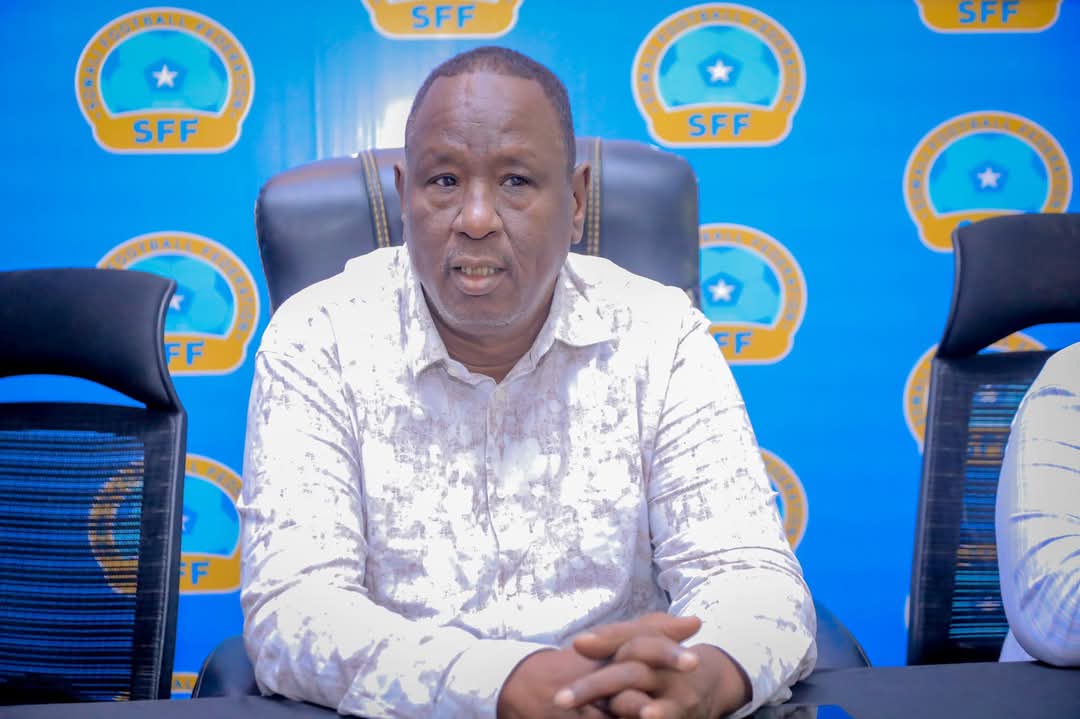
Somali Football at a Crossroads as Calls Grow for a Credible Electoral Process
By Kayiira Jackson
Somali football is heading towards another potentially defining moment, with the next leadership election expected to test the strength of its governance structures and the ability of its stakeholders to resolve long-running institutional disagreements.
The Somali Football Federation (SFF) has experienced several periods of leadership controversy in recent years, with disputes touching on the composition of member associations, changes involving association leadership, electoral structures and the legitimacy of decisions taken by competing groups.
The situation has raised questions among sections of the football community about whether the next electoral process can provide an outcome that is widely accepted by the federation’s stakeholders.
The leadership question became particularly contentious in June 2025 when a faction of the SFF Congress appointed Omar Mohamoud Nor, commonly known as Mugambe, as acting president. Reports at the time said the move followed an extraordinary congress convened by a breakaway group within the federation.
The development deepened an already existing leadership dispute and brought renewed attention to the role of the Electoral Committee and the procedures surrounding the convening of the congress.
The dispute is not without historical precedent. Somalia’s football administration has previously gone through periods of institutional disagreement, prompting FIFA to encourage stakeholders to use dialogue and follow the legal processes contained in the relevant statutes and regulations.
Against this background, the composition and independence of the electoral structures remain particularly important as the federation prepares for another electoral cycle.
For an election to command confidence, stakeholders will need clarity over who is eligible to participate, which member associations have voting rights, how the Electoral Committee is constituted and whether candidates and voters are being treated according to the same rules.
The issue extends beyond the presidential contest.
Somali football also faces the broader challenge of strengthening its domestic competitions, developing players and coaches, expanding opportunities for young footballers and ensuring that national teams have a stable football environment in which to compete.
FIFA’s current profile of the SFF lists Ali Abdi Mohamed as president, while the federation continues to conduct football development activities, including coaching courses and youth competitions.
That makes the question of governance particularly significant. A stable administrative structure is important not only for elections but also for the federation’s day-to-day football programmes.
The coming electoral process therefore presents an opportunity for Somali football stakeholders to address the issues that have repeatedly generated disagreement.
The SFF leadership, member associations, prospective candidates and other stakeholders have a shared interest in ensuring that the process is transparent and consistent with the federation’s statutes and applicable FIFA and CAF regulations.
FIFA and CAF also have an important role in supporting dialogue and ensuring that the applicable football governance framework is understood by all sides.
Rather than allowing competing interpretations of the rules to produce another cycle of disputes, stakeholders could use the period before the election to establish common ground on the electoral roadmap, membership, voting rights and the composition of the electoral bodies.
The objective should be straightforward: an election conducted through a process that is transparent, inclusive and constitutionally compliant, with the outcome determined by the legitimate football stakeholders.
Such an approach would allow the federation to move beyond questions of institutional legitimacy and concentrate on the areas that ultimately matter to players and supporters—competitions, youth development, women’s football, coaching, refereeing and the performance of Somalia’s national teams.
Somali football has an opportunity to turn its next election into more than a contest for leadership.
It can become a test of whether the country’s football administration can establish a governance framework capable of carrying the game forward without recurring disputes over the rules of engagement.
The responsibility rests with all stakeholders to ensure that the electoral process is clear, credible and conducted within the established football regulations.
For Somali football, the credibility of the process may be just as important as the result.